
Shikakai
Discover Shikakai for hair, its saponins, traditional cleansing role, scalp research, hair-growth evidence and important safety considerations.
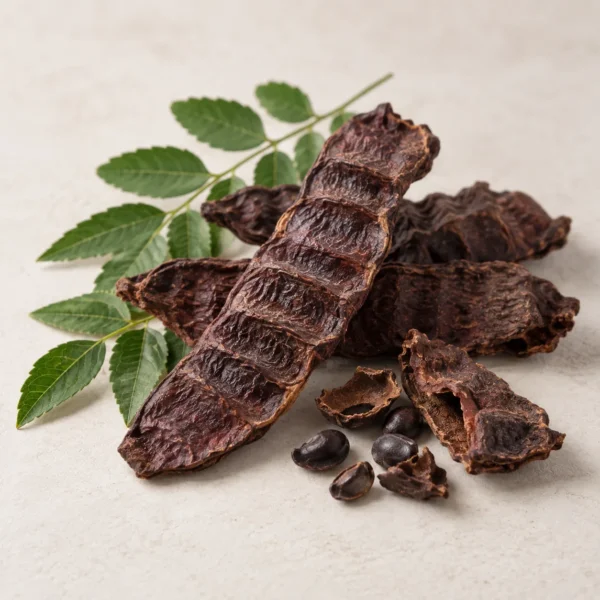
Origin
China to Tropical Asia, including India and much of South and Southeast Asia. (Plants of the World Online)
Traditional wisdom
Botanical hair cleansing
Why Soumm chose it
Natural cleansing and removal of excess oil and surface residue
Quick facts
- Botanical name
- Acacia concinna (Willd.) DC.; currently accepted by Kew as Senegalia rugata (Lam.) Britton & Rose. (Plants of the World Online)
- Common names
- Shikakai, Shikakai fruit, Soap-pod, Satala
- Source type
- Scrambling/climbing shrub
- Part used
- Dried fruit pods
- Natural constituents
- Saponins, including triterpenoid saponins; phenolic compounds and flavonoids.
- Scalp relevance
- Cleansing; preliminary evidence for improvement of some scaling and inflammatory scalp symptoms
- Evidence status
- Best supported as a botanical cleanser; limited clinical evidence for scalp benefits; hair-growth claims remain unestablished
The full guide
What Is Shikakai?
Shikakai is one of India's best-known traditional hair-cleansing botanicals. The name is commonly associated with Acacia concinna (Willd.) DC., the botanical name used in much of Ayurvedic, cosmetic and scientific literature. Kew currently treats Acacia concinna as a synonym of Senegalia rugata (Lam.) Britton & Rose, so both names may appear when researching the ingredient. (Plants of the World Online)
Shikakai is a climbing or scrambling shrub, and its pods are the part most closely associated with traditional hair washing. When dried and powdered or prepared in water, the pods produce a cleansing preparation because they are naturally rich in saponins—plant compounds that can behave like mild natural surfactants. (PubMed Central)
Its most meaningful role in hair care is therefore not as a miracle growth herb, but as a traditional botanical cleanser.
Where Does It Come From?
Under its currently accepted name, Senegalia rugata is native across a broad belt of Tropical Asia, including India, Bangladesh, Nepal, Myanmar, Thailand, parts of southern China and several regions of Southeast Asia. It grows primarily in seasonally dry tropical environments. (Plants of the World Online)
The plant's long association with India helped Shikakai become embedded in household hair-washing traditions. Its use also extends through Southeast Asia, where related traditional applications of the pods and other plant parts are documented. Over time, dried pods and powders became a practical way of bringing this botanical cleansing ritual into everyday bathing practices.
Its Traditional Story
In Indian hair care, Shikakai is traditionally prepared from dried pods, sometimes alongside other botanicals such as Amla and Reetha. The pods may be soaked, boiled or ground into a powder and mixed with water to create a cleansing wash. Traditional accounts describe it as a way to remove dirt and excess oil while leaving hair relatively soft and manageable. (Shri Dhanwantry Ayurvedic College)
The name itself is often explained through South Indian linguistic traditions as relating to hair and fruit. Ayurvedic and regional sources also associate Shikakai with hair and scalp care. These practices are valuable cultural knowledge, but their long history should not be interpreted as proof that Shikakai stimulates hair growth.
What Is Naturally Present Inside It?
The most important chemistry of Shikakai is its saponins.
Saponins are plant molecules with a structure that allows them to interact with both water and oily substances. In practical terms, this surface-active behaviour can help loosen and suspend oils, dirt and other residues so they can be rinsed away. This helps explain why Shikakai pods have traditionally functioned as a natural cleansing material. (PubMed Central)
Research has identified several triterpenoid saponins from Acacia concinna, including compounds known as concinnosides, together with acacic-acid-related structures. Other phytochemical investigations have detected phenolic compounds, flavonoids and other plant constituents. (PubMed)
The exact chemical profile depends on the plant part, extraction method and preparation, so a traditional pod powder, a water extract and a purified extract should not automatically be treated as chemically identical.
Hair Fibre
What Could It Mean for Hair and Scalp?
Shikakai's strongest relevance to the hair fibre is cleansing rather than repair.
Its saponins can help remove accumulated oil and surface residues from hair and scalp. A well-formulated cleanser can also improve manageability simply by keeping the fibre free from excess buildup.
However, there is not strong direct evidence showing that Shikakai repairs damaged cuticles, prevents protein loss or strengthens the hair shaft. Those claims should therefore remain outside what can reasonably be concluded from current evidence.
Scalp
The traditional cleansing action of Shikakai is more directly relevant to the scalp. Its naturally occurring saponins provide a plausible explanation for its ability to cleanse oily or dirty surfaces. Laboratory studies have also reported antimicrobial activity from Acacia concinna extracts, although laboratory activity should not be interpreted as proof that Shikakai treats a scalp infection. (PubMed Central)
There is also some human clinical research specifically involving Shikakai hair washing. One study of 70 people with Darunaka—an Ayurvedic scalp condition described with scaling, itching and dryness—reported improvement in several symptoms after a Shikakai hair wash used on alternate days for 28 days. The study is interesting, but it is not enough to establish Shikakai as a treatment for dandruff or seborrhoeic dermatitis in general. (jahm.co.in)
A separate controlled dermatology study of a soap-pod shampoo containing Acacia concinna included 74 people with seborrhoeic dermatitis. It found reductions in erythema and lesion extent, but did not find a significant reduction in dandruff scores. No serious adverse events were reported during the study. (Thai-Journal Online)
Hair Growth
This is where restraint matters most.
Shikakai is traditionally associated with healthy hair, and some traditional sources describe it as supporting hair growth. But there is insufficient high-quality human evidence to establish that Shikakai directly stimulates new hair growth or treats hair loss.
Its traditional importance is much better supported as a cleansing botanical than as a hair-growth active.
Beyond Hair
Shikakai has also been investigated for biological activities beyond hair care. Research has examined its antioxidant and antimicrobial properties, while traditional systems have used different plant parts for various household and medicinal purposes. (PubMed Central)
These findings are scientifically interesting, but they should not be turned into broad health claims. Evidence from an isolated extract or laboratory experiment does not automatically translate into benefits from using Shikakai as a cosmetic ingredient.
Best Supported
What Does Science Actually Say?
The strongest evidence supports Shikakai as a saponin-rich botanical cleansing material. Its surface-active compounds provide a reasonable chemical explanation for its longstanding use in hair washing. (PubMed Central)
Promising, But Not Established
Small clinical studies suggest that Shikakai-containing hair washes may improve some scalp symptoms, including scaling, itching and erythema. These findings are worth further investigation, but larger, well-controlled studies are needed. (jahm.co.in)
Traditional Rather Than Proven
Shikakai's use for maintaining clean, soft and manageable hair is deeply established in Indian household practice. Claims that it strengthens roots or promotes substantial hair growth remain primarily traditional rather than clinically established.
Not Established
Shikakai should not currently be described as a proven treatment for hair loss, baldness or follicular hair-growth disorders.
Safety and Practical Considerations
Shikakai has a long history of topical use, but “natural” does not automatically mean universally non-irritating. Cosmetic safety information for Acacia concinna fruit extract remains limited; a Cosmetic Ingredient Review assessment specifically concluded that available data were insufficient to establish the safety of Acacia concinna fruit extract as a cosmetic ingredient at that time. (PubMed)
Concentrated extracts and traditional powders are not necessarily equivalent. People with sensitive scalps should introduce new preparations cautiously and stop if burning, redness or persistent itching occurs. Avoid getting concentrated preparations into the eyes.
The Soumm Perspective
Shikakai is valuable because its traditional reputation has a surprisingly simple scientific foundation: its pods contain saponins that can help cleanse. That does not make it a miracle hair-growth ingredient—and it does not need to be one. At Soumm, we see Shikakai as a reminder that thoughtful hair wellness can begin with something as fundamental as understanding how we cleanse. Its strongest story is not about promising more hair, but about respecting a centuries-old botanical approach to keeping hair and scalp clean.