
Kalonji
Discover kalonji (black seed) oil for hair: its natural compounds, traditional uses, scalp relevance, hair-growth research, evidence limitations and safety.
Origin
Romania to West & Southwest Iran; including parts of the Mediterranean and West Asia. (Plants of the World Online)
Traditional wisdom
Culinary spice and traditional medicinal preparation
Why Soumm chose it
Potential scalp and follicular support; limited early research in telogen effluvium
Quick facts
- Botanical name
- Nigella sativa L.
- Common names
- Black Seed, Kalonji, Black Cumin, Black Caraway
- Source type
- Annual flowering herb; seed-derived oil
- Part used
- Seeds
- Natural constituents
- Linoleic and oleic fatty acids, thymoquinone, thymohydroquinone, thymol, carvacrol, phytosterols and other minor phytochemicals. (ScienceDirect)
- Scalp relevance
- Antioxidant, anti-inflammatory and antimicrobial research interest
- Evidence status
- Promising but limited human hair evidence; insufficient evidence for general hair-loss treatment
The full guide
What Is Black Seed?
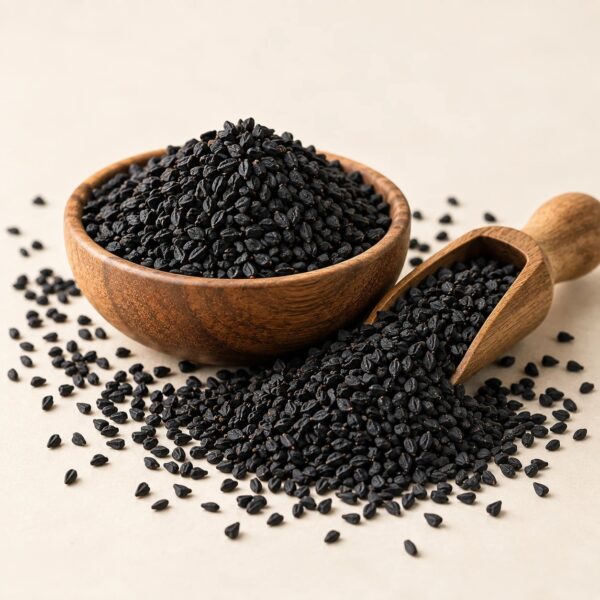
Black seed, botanically known as Nigella sativa L., is a small annual flowering plant belonging to the Ranunculaceae family. Its dark, aromatic seeds are commonly known as kalonji, black seed, or black cumin. The seeds are used as a culinary spice and as the source of black seed oil.
The oil is usually obtained from the seeds and contains a mixture of fixed oils and smaller amounts of volatile compounds. One of the best-studied constituents is thymoquinone, a naturally occurring compound that has attracted considerable scientific interest because of its antioxidant, anti-inflammatory and antimicrobial activity in laboratory and preclinical research. (PubMed)
For hair care, black seed oil is generally discussed as a scalp and hair-conditioning oil. But its popularity should not be confused with strong evidence that it can treat every form of hair loss.
Where Does It Come From?
Kew currently recognises Nigella sativa as an accepted species. Its native range extends from Romania through the Mediterranean and West and Southwest Asia to Iran, with countries including Türkiye, Syria-Lebanon, Iraq and Iran within its native distribution. It is an annual plant adapted primarily to temperate environments. It has subsequently been introduced and cultivated in many other regions, including India. (Plants of the World Online)
Today, kalonji is familiar across South Asia, the Middle East and North Africa, both as a food ingredient and as a traditional medicinal plant. Its seeds and oil have travelled particularly well because they can serve both culinary and household medicinal purposes.
Its Traditional Story
Black seed has a long history in several traditional medical systems. Reviews describe its use in Unani, Tibb, Ayurveda, Siddha and other traditional practices, as well as its longstanding role in Middle Eastern and South Asian food traditions. Traditional applications have included digestive, respiratory, inflammatory and skin-related concerns. (ScienceDirect)
In Ayurveda, Nigella sativa is identified in traditional materia medica under names including Upakunchika, while kalonji is also strongly associated with Unani and other Greco-Arabic traditions. Traditional knowledge gives the ingredient cultural importance and provides useful clues for modern research, but it does not by itself establish a treatment effect for hair loss.
What Is Naturally Present Inside It?
Black seed oil is chemically interesting because it contains both a fixed oil fraction and volatile compounds.
Its fixed oil is rich in unsaturated fatty acids, particularly linoleic acid, with oleic and palmitic acids also contributing substantially to its lipid profile. It also contains plant sterols and other minor lipid constituents. (ScienceDirect)
Among its better-known bioactive compounds are thymoquinone, thymohydroquinone, thymol, carvacrol and related quinones and alkaloids. Thymoquinone has received especially extensive research attention. However, the chemical profile can vary according to cultivar, growing conditions, extraction method and processing, so every black seed oil should not be assumed to have an identical composition. (PubMed)
What Could It Mean for Hair and Scalp?
Hair Fibre
Black seed oil can function as an oil-based conditioning ingredient, meaning it can lubricate hair and potentially improve the feel, smoothness and manageability of the fibre.
However, direct research demonstrating that black seed oil reduces hair protein loss, repairs damaged cuticles or prevents breakage is limited. Those effects should therefore not be presented as established specifically for Nigella sativa.
Its strongest scientific interest in hair lies elsewhere: the scalp and follicular environment.
Scalp
The phytochemistry of Nigella sativa provides a plausible reason for its use in scalp-focused formulations. Thymoquinone and other constituents have demonstrated antioxidant, anti-inflammatory and antimicrobial activity in laboratory and preclinical research. Human studies involving topical Nigella sativa preparations have also explored inflammatory and dermatological conditions, although these studies are not specifically hair studies. (ScienceDirect)
This distinction matters. A compound showing anti-inflammatory activity in cells does not automatically mean that applying black seed oil to a scalp will produce the same effect. Formulation, concentration, penetration and individual skin response all influence the outcome.
Hair Growth
There is some human evidence worth knowing about, but it is much smaller than online discussions often suggest.
A 2013 pilot study investigated a topical lotion containing 0.5% Nigella sativa in 20 people with telogen effluvium. Ten participants received the active lotion and ten received placebo for three months. The researchers reported improvements in hair density and thickness among those receiving the Nigella preparation. (SCIRP)
This is encouraging, but it is still early evidence. The study was very small, and the preparation was a formulation rather than simply pure black seed oil. The formulation also contained other ingredients, so the result cannot confidently be attributed to Nigella sativa alone.
There is therefore not enough evidence to say that black seed oil generally grows hair, reverses genetic hair loss or prevents shedding of every kind.
Beyond Hair
Black seed has been studied considerably more extensively for areas outside hair care. Reviews describe research involving inflammatory conditions, skin disorders, metabolic health, respiratory conditions and oxidative stress. Some human clinical studies have investigated topical Nigella sativa preparations for dermatological conditions, while other research has examined oral preparations. (Frontiers)
This broader research is scientifically interesting, but evidence for one condition or route of administration should not automatically be transferred to another. A topical black seed preparation studied for skin disease, for example, does not establish an effect on hair growth.
What Does Science Actually Say?
Best Supported
Black seed is a chemically active botanical containing fatty acids, thymoquinone and other phytochemicals. Antioxidant, anti-inflammatory and antimicrobial properties have been demonstrated particularly in laboratory and preclinical research. (PubMed Central)
Promising, But Not Established
A small pilot study involving a 0.5% Nigella sativa topical lotion reported improvements in hair density and thickness in people with telogen effluvium. This provides a reason for further research, not a basis for a universal hair-growth claim. (SCIRP)
Traditional Rather Than Proven
Black seed and its oil have extensive traditional use across several medical and cultural systems. This history is meaningful, but traditional use cannot establish that black seed oil treats a particular type of hair loss. (ScienceDirect)
Not Established
There is insufficient high-quality human evidence to conclude that black seed oil cures hair loss, reverses androgenetic alopecia, permanently increases hair density, or makes hair grow faster in otherwise healthy people.
Safety and Practical Considerations
Black seed oil is not automatically suitable for every scalp. Topical clinical studies have generally reported acceptable tolerability, but contact dermatitis and other skin reactions have been reported, including a published case of a severe delayed drug reaction following topical black seed oil. (PubMed Central)
For cosmetic use, product quality and formulation matter. Highly concentrated preparations or essential oil should not be treated as interchangeable with a properly formulated seed oil. People with sensitive skin should consider a small-area patch test before wider application.
Oral black seed oil is a different question from topical cosmetic use and should not be treated as interchangeable with it, particularly during pregnancy, breastfeeding or when taking medicines. For persistent scalp inflammation, sudden shedding or significant hair loss, professional assessment is more appropriate than relying exclusively on a home remedy.
The Soumm Perspective
Black seed is compelling precisely because it sits between tradition and modern research. Its chemistry is well studied, its cultural history is substantial, and early human hair research is interesting—but the evidence is still developing. At Soumm, understanding an ingredient means respecting both its potential and its boundaries. Black seed oil can be appreciated as a thoughtful botanical ingredient without turning a small clinical signal into a promise. Good hair wellness begins with knowing not only what an ingredient may offer, but also what science has not yet established.
Questions
Black seed oil is an interesting botanical ingredient for hair and scalp care, but its evidence is still developing. A small pilot study reported improvements in hair density and thickness in people with telogen effluvium using a 0.5% Nigella sativa lotion. This does not establish black seed oil as a general treatment for hair loss. (SCIRP)
There is limited human evidence suggesting possible benefits for hair density and thickness, but the evidence comes mainly from a small pilot study. It is therefore more accurate to describe black seed oil as promising but not established for hair growth rather than claiming that it reliably makes hair grow.
Black seed oil is obtained from the seeds of Nigella sativa. Its composition includes fatty acids such as linoleic and oleic acid, together with bioactive compounds including thymoquinone, thymol and carvacrol. The exact composition can vary according to seed variety, cultivation, processing and extraction method. (ScienceDirect)
Kalonji is the common South Asian name for the small black seeds of Nigella sativa. The seeds are used as a spice and in traditional medicine. They are sometimes called black cumin or black caraway, although Nigella sativa is botanically distinct from the cumin and caraway plants.
A small 2013 pilot study investigated a topical Nigella sativa preparation in people with telogen effluvium and reported improvements in hair density and thickness. However, the study was very small and used a multi-ingredient lotion. More rigorous research is needed before black seed oil can be considered an established treatment for hair shedding. (SCIRP)
Black seed contains compounds with antioxidant, anti-inflammatory and antimicrobial activity in laboratory and preclinical research. Some topical human studies have also investigated Nigella sativa for skin conditions. These findings make it scientifically interesting for scalp formulations, but they do not prove that black seed oil treats every scalp condition. (ScienceDirect)
There is not enough evidence to say that black seed oil treats baldness or reverses androgenetic alopecia. The limited hair research has focused on telogen effluvium rather than established genetic hair loss. Different causes of hair loss require different approaches, so persistent or progressive thinning should be evaluated professionally.
Many people may tolerate appropriately formulated black seed oil, but topical reactions are possible. Contact dermatitis has been reported, and a rare severe delayed reaction has also been documented after topical exposure. A patch test is a sensible precaution, particularly for people with sensitive or reactive skin.
No. Black seed's fixed oil and its volatile or essential-oil fraction have different compositions and concentrations. They should not be treated as interchangeable ingredients. In particular, a highly concentrated essential oil requires greater formulation and safety care than a conventional seed oil used as a cosmetic carrier.
Nigella sativa has a history in Indian traditional medicine and is identified in Ayurvedic literature under names including Upakunchika. It is also important in Unani and other traditional systems. Traditional recognition establishes cultural and medicinal history, however, rather than proving that black seed oil produces a particular modern hair-care outcome. (ScienceDirect)