
Neem
Learn how neem may support scalp care, what research says about dandruff and antimicrobial activity, its traditional uses, natural compounds and safety.
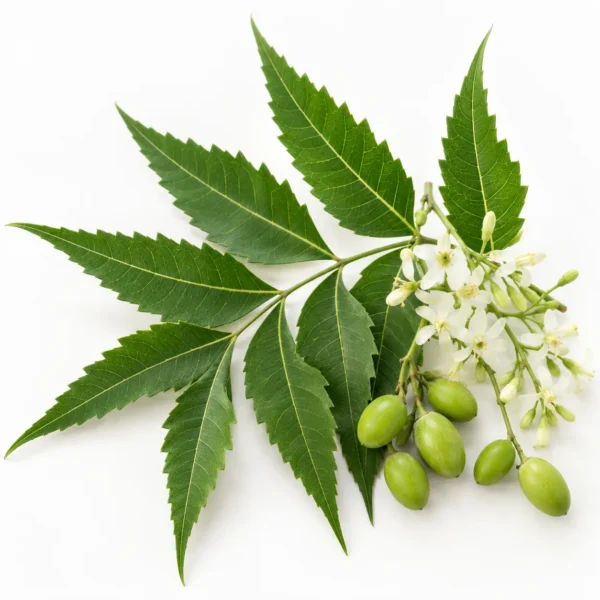
Origin
Assam through the Indian subcontinent to Indo-China
Traditional wisdom
Skin, hygiene, medicinal and household applications in Indian traditional practices
Why Soumm chose it
Scalp-focused care, particularly traditional dandruff and scalp-cleansing practices
Quick facts
- Botanical name
- Azadirachta indica A.Juss.
- Common names
- Neem, Nimba, Margosa
- Source type
- Evergreen tropical tree
- Part used
- Leaves, seeds/seed oil, bark, flowers and fruit
- Natural constituents
- Limonoids such as azadirachtin, nimbolide, nimbin and gedunin; flavonoids, phenolics and other terpenoid compounds
- Scalp relevance
- Potential antimicrobial and inflammation-related activity
- Evidence status
- Promising for certain scalp-related applications, but insufficient evidence to establish neem as a hair-growth or hair-loss treatment
The full guide
What Is Neem?
Neem is the common name for Azadirachta indica A.Juss., a large evergreen tree belonging to the Meliaceae, or mahogany, family. Although neem is often spoken about simply as a “herb,” botanically it is a tree.
Different parts of the neem tree—including leaves, flowers, bark, fruit and seeds—have been used in traditional practices. Neem oil is obtained primarily from the seeds, while leaves are commonly used in traditional topical preparations.
What makes neem particularly interesting to modern researchers is its unusually diverse chemistry. More than 100 compounds have been isolated from different parts of the plant, including limonoids, flavonoids, phenolic compounds and other secondary metabolites. Their biological activities are being studied in areas ranging from skin health to microbiology.
For hair and scalp care, however, an important distinction matters: research into neem's antimicrobial or anti-inflammatory potential does not automatically establish neem as a hair-growth treatment.
Where Does Neem Come From?
Neem's accepted botanical name is Azadirachta indica A.Juss. According to the Royal Botanic Gardens, Kew, its native range extends from Assam through parts of the Indian subcontinent and into Indo-China. It is primarily associated with tropical environments and has subsequently been introduced and cultivated across many tropical and subtropical regions of the world.
Its ability to tolerate warm conditions and relatively dry environments helped it become widely established beyond its original range. Today, neem is closely associated with India but is also cultivated in parts of Africa, Southeast Asia, the Caribbean and other tropical regions.
Its journey from a regional medicinal tree to a globally recognised botanical ingredient reflects both traditional knowledge and modern interest in its chemistry.
Neem's Traditional Story
Neem has a long history in Indian traditional medicine and household practices. In Ayurveda and related traditions, different parts of the tree have been used in preparations associated particularly with skin, hygiene and conditions described as involving irritation or infection.
Historical and ethnobotanical records also describe neem leaves and seed oil in Indian communities, alongside uses extending into dental care, household protection and agriculture. Traditional practices have varied considerably according to region and preparation.
Neem also became culturally significant beyond medicine. Its leaves have appeared in household practices and seasonal rituals, while its reputation for protecting against insects contributed to its widespread use.
These traditions are important evidence of how communities have understood and used neem over generations. They are not, by themselves, proof that every traditional claim produces the same result under modern clinical conditions.
What Is Naturally Present Inside Neem?
Neem is chemically complex, and its composition depends on which part of the tree is used and how it is extracted.
Researchers have identified several important groups of compounds, including limonoids, flavonoids, phenolic compounds, terpenoids and other plant secondary metabolites. Well-known neem constituents include azadirachtin, nimbolide, nimbin, nimbidin and gedunin.
Some of these compounds have demonstrated antimicrobial, antioxidant or inflammation-related activity in laboratory and experimental research. This is one reason neem continues to attract interest in dermatology and cosmetic science.
But the word neem does not describe one chemically identical substance. A fresh leaf, aqueous leaf preparation, concentrated leaf extract and cold-pressed neem seed oil can have very different compositions. Results obtained with one preparation should therefore not automatically be transferred to another.
Hair Fibre
What Could Neem Mean for Hair and Scalp?
Neem is not primarily known as a conditioning oil, so its relevance to the hair fibre is different from that of oils such as coconut oil.
There is limited evidence that neem directly improves properties such as hair strength, protein retention or cuticle integrity. Its traditional and cosmetic relevance is more strongly connected with the scalp environment than with direct structural modification of the hair shaft.
A healthier scalp environment can be useful for overall hair care, but this should not be confused with evidence that neem itself strengthens or accelerates hair growth.
Scalp
This is where neem becomes more scientifically interesting.
Laboratory studies have found antimicrobial activity in neem extracts against various microorganisms, including some organisms relevant to skin and scalp conditions. Research has also explored anti-inflammatory and antioxidant activities associated with neem constituents.
There is also emerging human evidence. A 2025 study involving 100 young women reported a reduction in dandruff scores after topical application of neem leaf paste over a short treatment period. However, the study was quasi-experimental rather than a large, rigorous randomized clinical trial, so its findings should be viewed as promising rather than definitive.
This distinction matters. Neem may have a useful role in scalp-care formulations designed around microbial balance or scalp comfort, but it should not automatically be described as a treatment for every form of dandruff, seborrheic dermatitis or scalp infection.
Hair Growth
The evidence here is considerably weaker.
Neem is frequently included in traditional hair-care preparations and modern herbal formulations marketed for hair growth. However, this popularity is not equivalent to strong clinical evidence that isolated neem stimulates human hair follicles or treats alopecia.
Some experimental hair formulations containing neem have been investigated, but when several botanicals are combined, their individual contribution cannot be determined reliably. Current evidence therefore does not establish neem as a proven human hair-growth treatment.
For someone experiencing persistent or significant hair loss, identifying the underlying cause remains much more important than choosing a particular botanical ingredient.
Beyond Hair
Neem has been studied extensively in dermatology and traditional medicine.
Reviews describe antimicrobial, anti-inflammatory and antioxidant activities associated with different neem preparations, with particular interest in skin-related applications. Much of this evidence comes from laboratory, animal or formulation research rather than high-quality clinical trials.
Neem also has a long history of use in traditional medicine for a broad range of concerns. Modern research has investigated its constituents in areas including microbial biology, inflammation, metabolic health and other biological pathways. These findings are scientifically interesting, but they should not be interpreted as evidence that neem is a universal remedy.
Best Supported
What Does Science Actually Say?
Neem contains diverse bioactive compounds, and laboratory research supports antimicrobial and inflammation-related biological activity in various extracts. Its potential relevance to skin and scalp microbiology is therefore scientifically plausible.
Promising, But Not Established
Early human research suggests that topical neem leaf preparations may help reduce dandruff, but stronger randomized and independently replicated clinical studies are needed before firm conclusions can be made.
Traditional Rather Than Proven
Neem's long-standing use in Ayurveda and Indian household practices gives it substantial cultural and traditional significance. That history helps explain its popularity in scalp and skin care, but traditional use should not be treated as clinical proof.
Not Established
Neem has not been established as a clinically proven treatment for hair loss or a guaranteed hair-growth ingredient. Claims that neem “stops hair fall” or directly regrows hair go beyond the available evidence.
Safety and Practical Considerations
“Natural” does not automatically mean irritation-free.
Neem oil has been associated with cases of allergic contact dermatitis, including reactions involving the scalp and face. Neem leaves have also been implicated in individual allergic reactions. Anyone with sensitive skin should therefore consider a small patch test before broader topical use and discontinue use if burning, swelling, itching or a rash develops.
Neem preparations also differ substantially depending on whether they contain leaves, seed oil, extracts or concentrated active fractions. Topical cosmetic use should not be equated with oral consumption. Neem oil ingestion can be particularly hazardous, especially in young children, and concentrated preparations should not be casually self-administered.
People who are pregnant, breastfeeding, treating a medical condition, taking medicines, or considering oral neem preparations should seek qualified professional advice rather than assuming that traditional use guarantees safety.
The Soumm Perspective
Neem is a good example of why thoughtful wellness begins with understanding rather than assumption. Its traditional place in Indian self-care is substantial, and modern research gives us legitimate reasons to study its antimicrobial and inflammation-related properties—particularly for the scalp. But science also tells us where the boundaries are. Neem is interesting, useful and culturally important without needing to be presented as a miracle. For Soumm, that distinction is part of responsible ingredient knowledge: respect tradition, examine evidence, and remain honest about what we still do not know.
Questions
Neem has a long history of topical use in Indian traditions, and laboratory research suggests antimicrobial and inflammation-related activity in some neem preparations. Early human research has also reported improvements in dandruff with neem leaf paste. However, evidence is still limited, and neem should be viewed as a supportive scalp-care ingredient rather than a universal treatment.
Possibly. Laboratory studies have demonstrated antimicrobial activity from neem extracts, and a 2025 quasi-experimental study reported reduced dandruff scores after topical neem leaf paste. However, this is not yet equivalent to strong clinical evidence. Persistent or severe dandruff may require evidence-based medicated treatment and professional assessment.
There is not enough high-quality human evidence to say that neem directly accelerates hair growth. Neem's traditional use and laboratory properties have generated interest in hair care, but those findings do not establish follicular hair growth. Claims that neem is a proven treatment for hair loss therefore go beyond current evidence.
Neem has not been clinically established as a treatment that stops hair loss. Hair shedding can have many causes, including genetics, hormonal changes, nutritional factors, illness and scalp disorders. Neem may have a role in scalp-focused care, but persistent or significant hair loss deserves evaluation rather than relying on a single botanical ingredient.
Neem leaves and neem seed oil are among the most commonly discussed preparations in hair and scalp care. However, they are chemically different materials. A leaf extract, fresh leaf paste and cold-pressed seed oil should not be treated as interchangeable, because extraction method and plant part influence the compounds present.
Yes. Neem, known as Nimba in Ayurvedic tradition, has a long history of use in Indian traditional medicine, particularly in practices relating to skin, hygiene and various illnesses. Historical use provides important cultural context, but it should be distinguished from modern clinical evidence.
Traditional practices include topical neem preparations, but “neem” can refer to very different materials. Concentrated extracts and neem oil are not equivalent to diluted or traditionally prepared leaf products. Because neem can occasionally cause skin reactions, a cautious approach and patch testing are sensible for people trying a new topical preparation.
No ingredient is universally suitable for everyone. Neem oil has been reported to cause allergic contact dermatitis, including reactions affecting the scalp and face. Oral neem preparations raise additional safety concerns and should not be assumed to be equivalent to topical cosmetic use. Children, pregnant or breastfeeding individuals and people taking medicines should seek professional guidance.
No. Neem refers to the plant, Azadirachta indica, while neem oil is a specific preparation obtained primarily from its seeds. Leaves, leaf extracts and seed oil contain different mixtures of compounds. Therefore, evidence about one neem preparation should not automatically be used to make claims about every neem-containing product.
Not necessarily. Natural ingredients can be valuable, but their usefulness depends on preparation, concentration, formulation and individual tolerance. Neem has interesting biological properties, yet it can also cause allergic reactions in some people. Good scalp care is ultimately about suitability, evidence and formulation—not simply whether an ingredient is natural.