
Reetha
Explore Reetha benefits, traditional uses and the science behind Sapindus mukorossi, including its natural cleansing saponins and relevance to hair and scalp care.
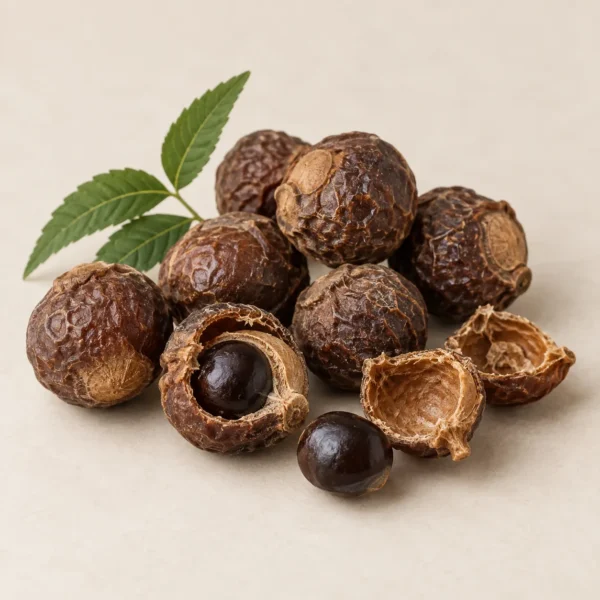
Origin
Southern China; now introduced or cultivated across parts of the Indian subcontinent and wider Asia. (Plants of the World Online)
Traditional wisdom
Natural cleansing of hair, body, fabrics and household materials
Why Soumm chose it
Plant-derived cleansing and surfactant action
Quick facts
- Botanical name
- Sapindus mukorossi Gaertn.
- Common names
- Soapnut; Aritha; Ritha; Reetha; Washnut
- Source type
- Deciduous subtropical tree
- Part used
- Fruit pericarp — the outer fleshy covering of the fruit
- Natural constituents
- Triterpenoid saponins, sugars, mucilage and other plant compounds including phenolics and flavonoids. (PubMed Central)
- Scalp relevance
- Cleansing; possible antimicrobial relevance based mainly on laboratory and formulation research
- Evidence status
- Strongest evidence supports its cleansing/surfactant role; evidence for direct hair growth or treatment of scalp disorders is insufficient.
The full guide
Reetha, also called soapnut or Aritha, is one of India's best-known traditional botanical cleansers. Its story is slightly different from that of many herbs used in hair care: Reetha is valued primarily not because it is thought to “feed” the hair, but because its fruit naturally contains saponins—plant compounds with surfactant properties that help water interact with oils and dirt.
The accepted botanical name is Sapindus mukorossi Gaertn. It is a deciduous tree belonging to the Sapindaceae family. The fruit pericarp, or outer fleshy covering of the fruit, is the part most commonly used for cleansing. (Plants of the World Online)
Where Does Reetha Come From?
Kew records Sapindus mukorossi as native to southern China, with the species now introduced or cultivated across parts of the Indian subcontinent, East and Southeast Asia and other regions. It is primarily associated with subtropical environments. In India, it is particularly familiar in Himalayan and other northern regions, although it is cultivated elsewhere as well. (Plants of the World Online)
The fruit became valuable because its outer covering produces foam when mixed with water. This made Reetha useful not only for personal cleansing but also for washing fabrics and other household purposes. Its reputation as a “natural soap” therefore comes from a real physical property of the fruit rather than simply from traditional naming. (FDA Taiwan)
The Traditional Story
Reetha has a long history in Indian household and traditional practices. The Ministry of AYUSH's e-Charak database lists Sapindus mukorossi as Reetha and identifies the fruit as the medicinally used plant part. Traditional Indian practices have also used the fruit's outer covering for cleansing hair and the body. (eCharak)
This traditional role is particularly interesting because it connects directly with the chemistry of the plant. Reetha was not simply chosen because it was believed to be good for hair; its fruit could actually produce a cleansing lather when prepared with water. Traditional use therefore has a practical, observable foundation. That said, traditional cleansing use should not be interpreted as proof that Reetha treats hair loss or scalp disease.
What Is Naturally Present Inside It?
The most important constituents of Reetha are triterpenoid saponins, concentrated particularly in the fruit pericarp. Saponins are naturally occurring plant compounds with both water-attracting and oil-interacting parts. This makes them surfactants—substances that can reduce surface tension and help disperse oils and other material in water. (PubMed Central)
The fruit pericarp also contains sugars and mucilage, while other parts of the plant contain additional compounds including flavonoids, phenolics and other triterpenoid saponins. The exact chemical profile varies according to the plant part and extraction method. (PubMed Central)
This chemistry explains Reetha's most established cosmetic role: cleansing.
Hair Fibre
What Could It Mean for Hair and Scalp?
Reetha's primary relevance to hair is as a cleansing ingredient, rather than as a direct hair-growth ingredient.
Because its saponins have surfactant properties, Reetha extracts can help remove oils, dirt and other materials during washing. Research on formulations containing Sapindus mukorossi has evaluated properties such as detergency, foaming, wetting and surface tension. (FDA Taiwan)
However, cleansing and conditioning are not the same thing. There is insufficient evidence to conclude that Reetha directly strengthens the hair shaft, prevents protein loss, repairs damaged cuticles or improves tensile strength. A cleanser can contribute to good hair hygiene without itself being a hair-repair treatment.
Scalp
Reetha is also interesting for scalp care because its saponins provide a naturally derived cleansing system. Laboratory research has reported antimicrobial activity from S. mukorossi extracts and saponin fractions, giving researchers a reason to investigate the plant in cosmetic and scalp formulations. (PubMed Central)
There are also studies of multi-ingredient shampoos containing Reetha alongside other botanicals. One six-week study of a herbal and zinc-pyrithione-based shampoo and scalp lotion reported improvements in dandruff and seborrhoeic dermatitis symptoms, but because several active ingredients were present, the result cannot be attributed to Reetha alone. (PubMed Central)
Hair Growth
This distinction is especially important.
Reetha is not established as a hair-growth treatment. There is no strong human clinical evidence showing that washing the scalp with Reetha stimulates follicles, reverses alopecia or directly increases hair density.
Its traditional reputation in hair care is primarily connected to cleansing, not demonstrated follicular stimulation. Keeping that distinction clear prevents a useful botanical cleanser from being burdened with claims the evidence cannot support.
Beyond Hair
Reetha's applications extend well beyond hair. Its saponins have attracted interest as plant-derived surfactants for cosmetic, pharmaceutical, food and cleaning applications. Research has explored their foaming, emulsifying and antimicrobial properties. (PubMed Central)
Reetha has also been investigated in skin-related formulations. A 2021 study examined a purified Sapindus mukorossi saponin fraction as a potential cosmetic ingredient and explored biological activity relevant to acne research. Such findings are promising for formulation science, but they do not mean that household Reetha preparations are established acne treatments. (ScienceDirect)
Best Supported
What Does Science Actually Say?
The strongest evidence concerns Reetha's cleansing chemistry. Its fruit pericarp is rich in triterpenoid saponins with genuine surfactant properties, explaining its traditional use as a natural cleanser. (PubMed Central)
Promising, But Not Established
Laboratory research indicates antimicrobial and other biological activities, while cosmetic formulation studies suggest potential applications in shampoos and other cleansing products. These findings are useful for formulation research but do not establish specific therapeutic effects in humans. (PubMed Central)
Traditional Rather Than Proven
Using Reetha fruit preparations to wash hair and the body is a well-established traditional practice in parts of South Asia. Its usefulness as a cleanser has a clear practical basis, but traditional use does not prove treatment of hair or scalp disorders.
Not Established
Claims that Reetha grows new hair, stops hair fall, reverses baldness, prevents greying or cures dandruff on its own are not supported by adequate evidence.
Safety and Practical Considerations
Reetha should not automatically be considered gentle simply because it is plant-derived. Saponins are biologically active surfactants, and concentrated preparations can behave differently from traditionally diluted washes.
Experimental studies have reported relatively favourable dermal safety findings for certain Reetha saponin preparations, including human patch testing without allergic reactions in one study. However, the same review notes that toxicity should not simply be dismissed and that preparation and concentration matter. (PubMed Central)
Reetha can also irritate the eyes, so contact should be avoided. People with sensitive skin or scalp should introduce any new preparation cautiously and discontinue use if persistent burning, itching, redness or irritation occurs.
The Soumm Perspective
Reetha is a useful reminder that traditional beauty ingredients do not all need to be framed as “growth boosters.” Its most compelling story is simpler and more honest: a fruit whose natural saponins give it genuine cleansing ability, which helps explain its place in Indian hair-care traditions. At Soumm, understanding that distinction matters. An ingredient becomes more meaningful when we understand not only what it may do, but also the role it is actually equipped to play.