
Vetiver Root
Explore vetiver root benefits, traditional uses and modern research on Khus for hair, scalp, skin, fragrance and everyday wellness.
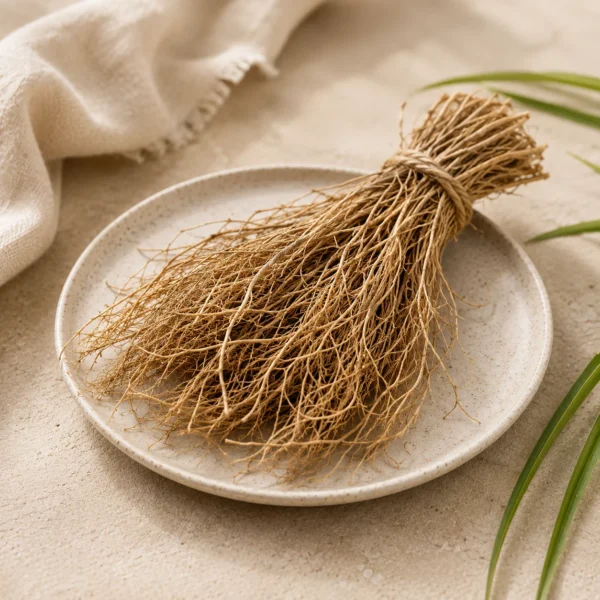
Origin
Northeastern India through Indochina, including Bangladesh, Myanmar, Thailand, Laos, Cambodia and Vietnam. (Plants of the World Online)
Traditional wisdom
Cooling, aromatic and traditional medicinal applications; also used in summer cooling rituals and perfumery.
Why Soumm chose it
Traditional inclusion in hair and scalp preparations; direct hair-fibre and hair-growth evidence remains limited.
Quick facts
- Botanical name
- Chrysopogon zizanioides (L.) RobertyVetiveria zizanioides is a widely used synonym.
- Common names
- Khus; Vetiver; Khus-khus; Ushira/Uśīra
- Source type
- Perennial aromatic grass
- Part used
- Roots
- Natural constituents
- Khusimol, α-vetivone, β-vetivone, vetiselinenol, isovalencenol and other sesquiterpenes, alongside phenolic compounds. (PubMed Central)
- Scalp relevance
- Potential antioxidant and antimicrobial relevance based mainly on experimental research.
- Evidence status
- Strong traditional and aromatic relevance; promising preclinical research, but insufficient clinical evidence for direct hair-growth claims.
The full guide
Few Indian botanicals are as recognisable by their fragrance as vetiver root, known widely as Khus or Khus-khus. Unlike many aromatic plants whose leaves or flowers provide their characteristic scent, vetiver stores its distinctive earthy, woody aroma primarily in its roots.
The botanical name currently accepted by Kew is Chrysopogon zizanioides (L.) Roberty. Older literature frequently uses the name Vetiveria zizanioides, which is a synonym. It is a perennial grass belonging to the Poaceae family, and its aromatic roots are the part most valued for traditional, aromatic and cosmetic applications. (Plants of the World Online)
Where Does Vetiver Come From?
Kew records Chrysopogon zizanioides as native from northeastern India through Indochina, including India, Bangladesh, Myanmar, Thailand, Laos, Cambodia and Vietnam. It is particularly associated with wet tropical environments. The plant forms dense clumps with an extensive root system, which has also made it valuable for controlling soil erosion and stabilising landscapes. (Plants of the World Online)
From South and Southeast Asia, vetiver travelled into tropical regions around the world. Today it is cultivated in countries including India, Haiti, Indonesia and Réunion, among others, for its roots and essential oil. Its roots have therefore moved from being a traditional Indian aromatic material to becoming an internationally recognised ingredient in perfumery, cosmetics and other industries. (PubMed Central)
The Traditional Story
In Ayurveda, vetiver is known as Uśīra (Ushira) and has traditionally been valued particularly for its cooling and aromatic qualities. The dried root has been used in traditional preparations, cooling drinks and aromatic applications, while its fragrance has long been associated with summer rituals in India.
One familiar example is the traditional khus screen: woven vetiver roots were moistened so that passing air carried their characteristic fragrance and a cooling sensory experience. Vetiver roots have also been used traditionally in preparations associated with fever, thirst, digestion, inflammation and skin-related concerns. These are historical and traditional uses, however, and should not be interpreted as proof of clinical treatment. (PubMed Central)
What Is Naturally Present Inside Vetiver Root?
Vetiver root is particularly interesting because of its aromatic essential oil. Unlike many familiar essential oils dominated by monoterpenes, vetiver oil contains a complex mixture of sesquiterpenes and their derivatives.
Important constituents reported across different vetiver oils include khusimol, α-vetivone, β-vetivone, vetiselinenol, isovalencenol and related sesquiterpenes. The precise composition can vary with plant genetics, geographical origin, cultivation conditions, extraction method and even the particular cultivar. (PubMed Central)
Vetiver roots also contain phenolic compounds and other secondary plant metabolites that have attracted research interest because of their antioxidant and biological activities. This chemical diversity helps explain why vetiver has applications extending beyond fragrance.
Hair Fibre
What Could It Mean for Hair and Scalp?
This is where the evidence needs to remain measured.
Vetiver is traditionally incorporated into some hair oils and aromatic preparations, but there is not strong direct evidence that vetiver root protects the human hair fibre from protein loss, reduces breakage, improves tensile strength or increases hair-shaft moisture retention.
Its greatest cosmetic contribution may therefore be contextual: fragrance, sensory character and its potential role within a broader botanical formulation. Claims that vetiver itself strengthens or transforms the hair fibre have not been adequately demonstrated in controlled human studies.
Scalp
Vetiver is more scientifically interesting from a scalp-environment perspective.
Laboratory studies of vetiver essential oil have demonstrated antimicrobial activity against several microorganisms, while other experimental work has reported antioxidant and anti-inflammatory activity. These findings provide a plausible basis for investigating vetiver in topical cosmetic formulations designed around a balanced skin environment. (PubMed)
There is also emerging cosmetic research around vetiver-derived extracts and skin biology. A 2021 study reported that a vetiver root extract influenced skin-lipid production and markers associated with epidermal barrier function in laboratory skin-cell models. This is interesting for skin science, but cell studies are not equivalent to demonstrated clinical benefits in people. (PubMed Central)
Hair Growth
There is currently insufficient evidence to establish vetiver root as a direct hair-growth ingredient.
Vetiver's traditional presence in hair oils should not be confused with clinical evidence for treating hair loss. Similarly, antioxidant, antimicrobial or anti-inflammatory activity in laboratory experiments does not demonstrate that vetiver can reactivate dormant follicles or reverse alopecia.
For Soumm, this distinction matters: an ingredient can be valuable within a thoughtful hair-wellness ritual without needing an exaggerated hair-growth claim attached to it.
Beyond Hair
Vetiver has a much broader identity than a cosmetic ingredient.
Its roots are highly valued in perfumery and aromatics, while the plant itself has important environmental applications because its dense root system can help stabilise soil and reduce erosion. (Plants of the World Online)
Research has also explored antioxidant, antimicrobial, anti-inflammatory, wound-healing and other biological activities. Much of this evidence remains preclinical, involving laboratory experiments, extracts, isolated compounds or animal models. A 2025 review concluded that the pharmacological potential is considerable but also highlighted the need for further research, particularly around clinical translation. (PubMed)
Best Supported
What Does Science Actually Say?
Vetiver is a chemically complex aromatic root with a well-established role in fragrance and perfumery. Its essential oil contains numerous sesquiterpenes, with compounds such as khusimol and vetivones frequently identified among its characteristic constituents. (PubMed Central)
Promising, But Not Established
Laboratory studies suggest antioxidant, antimicrobial and anti-inflammatory properties, while emerging skin-cell research indicates that vetiver-derived extracts may interact with skin-lipid and barrier biology. These findings justify further cosmetic and dermatological investigation but do not establish clinical outcomes. (ScienceDirect)
Traditional Rather Than Proven
Vetiver's cooling, aromatic and traditional medicinal uses are deeply established within South Asian practice. Its use in summer cooling rituals, traditional preparations and aromatic applications is part of its cultural significance. Traditional experience, however, should remain distinct from modern clinical evidence. (PubMed Central)
Not Established
There is no strong human evidence that vetiver root directly grows hair, reverses hair loss, prevents greying or treats dandruff. These claims should not be inferred from its traditional use or from laboratory antimicrobial and antioxidant findings.
Safety and Practical Considerations
Vetiver root and its oil have a long history of aromatic and cosmetic use, but essential oil is a concentrated preparation and should not be treated as equivalent to the whole root.
Contact allergy to vetiver oil has been reported, and the fragrance-safety literature identifies vetiver extracts/oils as possible fragrance allergens. Properly formulated topical products should therefore use appropriate concentrations, while people with sensitive skin or fragrance allergies may benefit from patch testing. (Taylor & Francis)
Safety also depends on the preparation and route of use. A recent animal toxicology study of a hydroalcoholic vetiver-root extract found generally acceptable findings at studied doses, while higher repeated oral exposure produced mild liver changes in rats. This does not establish equivalent risks from normal topical cosmetic use, but it reinforces an important principle: whole roots, extracts and essential oils are not interchangeable. (PubMed)
The Soumm Perspective
Vetiver reminds us that an ingredient can have value without needing to promise everything. Its roots carry a distinctive fragrance, a long Indian cultural history and a fascinating chemistry that continues to interest researchers. For hair wellness, the evidence is still modest, particularly for direct hair-growth or hair-fibre claims. But understanding its sensory, traditional and scientific dimensions allows us to appreciate vetiver more honestly. At Soumm, that distinction matters: thoughtful rituals begin with knowing what an ingredient is—and equally, what it is not.