
Fenugreek
Explore fenugreek for hair and scalp care, from traditional methi seed use to its natural compounds, possible benefits, scientific evidence and safety.
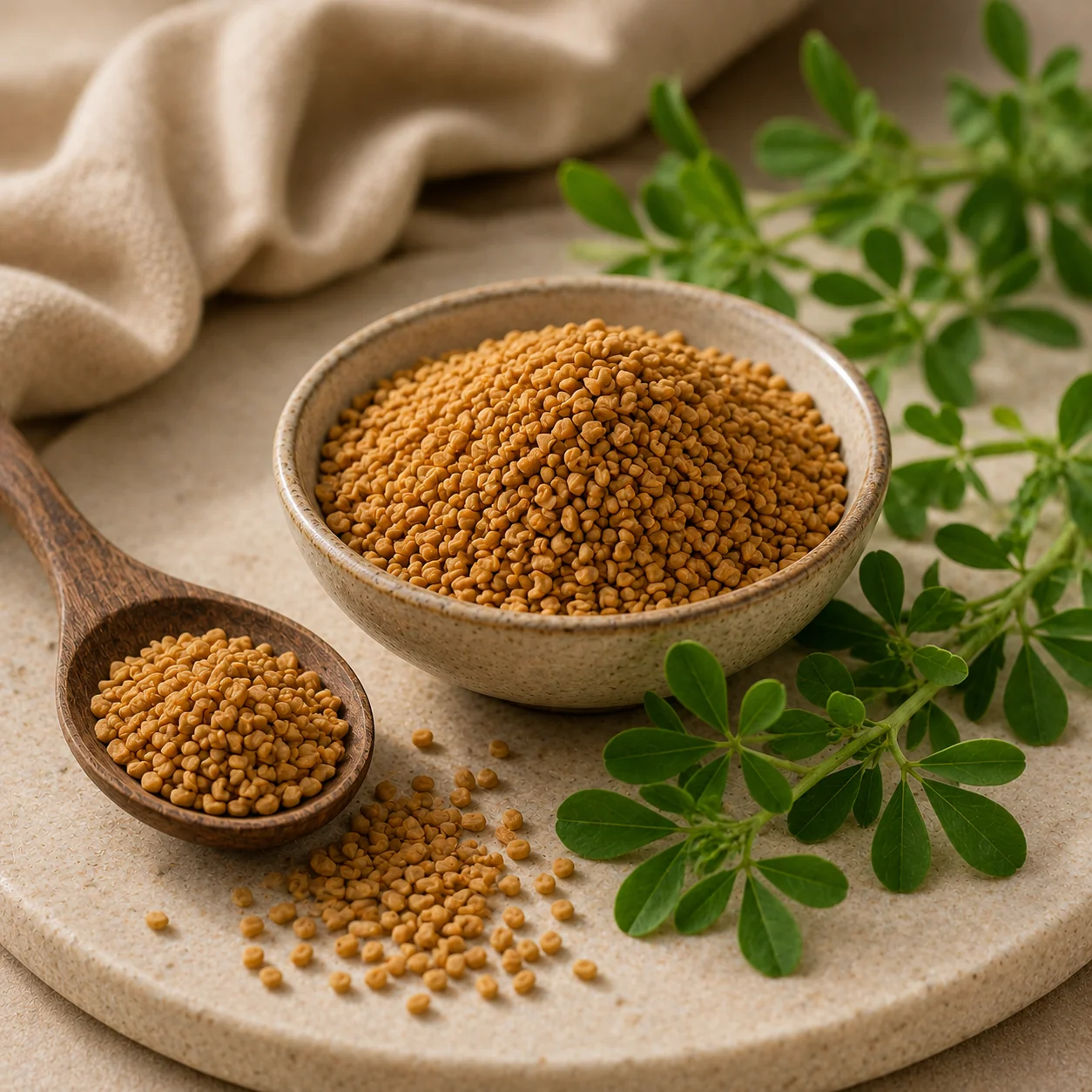
Origin
Iraq through Iran and Afghanistan to northern Pakistan (Plants of the World Online)
Traditional wisdom
Culinary and medicinal use, with household use of soaked or ground seeds in hair and scalp preparations
Why Soumm chose it
Potential film-forming, coating and conditioning effects from seed mucilage
Quick facts
- Botanical name
- Trigonella foenum-graecum L.
- Common names
- Fenugreek, Methi, Hulba
- Source type
- Annual herb in the legume family (Fabaceae)
- Part used
- Seeds and leaves; seeds are particularly common in traditional hair preparations
- Natural constituents
- Galactomannans and mucilage, proteins, saponins, trigonelline, flavonoids, polyphenols and fatty acids
- Scalp relevance
- Experimental antioxidant, antimicrobial and inflammation-related activity
- Evidence status
- Traditional use and promising cosmetic science; insufficient high-quality human evidence for direct hair-growth claims
The full guide
What Is Fenugreek?
Fenugreek, or Trigonella foenum-graecum L., is an aromatic annual plant in the legume family, Fabaceae. In India, it is widely known as methi. Both its leaves and seeds are familiar foods, but the hard, yellow-brown seeds are especially important in traditional preparations and modern botanical research.
Fenugreek has attracted scientific interest because its seeds contain a distinctive combination of mucilage-forming polysaccharides, proteins, saponins, flavonoids, polyphenols and alkaloids such as trigonelline. These constituents help explain why fenugreek is studied across nutrition, metabolic health, skin and cosmetic science. Its reputation in hair care, however, is considerably older than the clinical evidence supporting it. (PubMed)
Where Does It Come From?
Fenugreek has travelled so widely through food and traditional medicine that its beginnings can easily become blurred. Current botanical data from the Royal Botanic Gardens, Kew, place the species' native range from Iraq through Iran and Afghanistan to northern Pakistan. It is an annual plant associated primarily with temperate environments. (Plants of the World Online)
Over centuries of cultivation and trade, fenugreek became established far beyond this native range. It is now strongly associated with India and is cultivated across parts of Asia, the Mediterranean region, Africa and elsewhere. In India, methi became simultaneously a food, spice and traditional household botanical—one reason it remains so familiar in everyday wellness practices. (Plants of the World Online)
Its Traditional Story
Fenugreek has centuries of documented culinary and medicinal use across traditional systems. In South Asia, methi seeds and leaves became part of everyday food culture as well as household preparations. Traditional medicine has associated fenugreek with digestive, metabolic and women's-health uses, while traditional beauty practices have also incorporated soaked or ground seeds into preparations for the hair and scalp. Unani literature similarly records Trigonella foenum-graecum, known as Hulba or Methi, as a medicinal plant. (PubMed)
For hair, soaked methi seeds are commonly transformed into a paste or incorporated into botanical preparations. These practices are valuable ethnobotanical knowledge, but their long history should not be interpreted as clinical proof that fenugreek prevents hair loss or regrows hair.
What Is Naturally Present Inside It?
Fenugreek seeds are nutritionally and phytochemically rich. They contain protein and amino acids, along with soluble fibre and a particularly interesting group of water-binding carbohydrates called galactomannans. These contribute to the slippery, gel-like mucilage that develops when the seeds are soaked in water. (PubMed)
Researchers have also identified steroidal saponins, flavonoids, polyphenols and trigonelline, a naturally occurring plant alkaloid. Fenugreek also contains fatty acids, minerals and other micronutrients. (PubMed)
Many of these constituents demonstrate antioxidant, antimicrobial or inflammation-related activity in experimental research. However, detecting a beneficial compound inside a seed does not prove that applying the whole seed to the scalp will produce the same biological effect in people.
Hair Fibre
What Could Fenugreek Mean for Hair and Scalp?
Fenugreek's most straightforward cosmetic relevance may come from its mucilage.
When soaked, fenugreek seeds produce a viscous material rich in galactomannans. These polysaccharides bind water and form films, properties that make them interesting in cosmetic formulations. On hair, a mucilage-containing preparation could potentially provide temporary coating, slip and easier manageability. (DOI)
That is different from repairing the internal structure of damaged hair. Direct human evidence showing that fenugreek prevents hair-protein loss, permanently strengthens the cuticle or reverses existing fibre damage remains limited.
Scalp
Fenugreek extracts have demonstrated antioxidant, antimicrobial and anti-inflammatory activity in experimental research. These properties have created interest in fenugreek for skin and scalp formulations. (PubMed)
Its mucilage may also provide a soothing, water-binding cosmetic effect. But much of the evidence comes from laboratory work, ingredient-characterisation studies or experimental formulations—not large clinical trials conducted specifically on scalp conditions.
Fenugreek therefore has promising scalp-care potential, but it should not be described as a proven treatment for dandruff, dermatitis or other scalp disorders.
Hair Growth
This is where evidence requires particular restraint.
Fenugreek appears in experimental herbal hair-growth preparations, including animal research. A 2008 study, for example, investigated botanical hair oils containing ingredients including fenugreek, but such multi-ingredient experimental research cannot establish that fenugreek alone causes human hair growth. (ResearchGate)
A recent cosmetic-science review also identified emerging research into fenugreek-based topical preparations while emphasizing the limited direct clinical evidence. (DOI)
At present, there is insufficient high-quality human evidence to establish methi seeds as a treatment that regrows hair or stops clinically significant hair loss.
Beyond Hair
Fenugreek is considerably better studied as a food and nutritional botanical than as a hair ingredient. Research has examined its possible effects on blood glucose and lipid metabolism, among other areas, while experimental work has explored antioxidant and inflammation-related activity. (PubMed)
These areas should remain separate from hair claims: evidence for an oral metabolic effect, for example, does not demonstrate a topical benefit to a hair follicle.
Best Supported
What Does Science Actually Say?
Fenugreek is a well-characterised food and medicinal plant containing galactomannans, proteins, saponins, polyphenols, flavonoids and trigonelline. Its mucilage has useful water-binding and film-forming properties. (PubMed)
Promising, But Not Established
Experimental research suggests antioxidant, antimicrobial and inflammation-related activities that could be relevant to scalp and cosmetic formulations. Hair-related research exists, but robust independent human trials remain limited.
Traditional Rather Than Proven
Using soaked methi seeds, pastes and botanical preparations for hair and scalp care belongs largely to traditional and household practice.
Not Established
Fenugreek has not been established as a treatment for alopecia, guaranteed hair growth, or a way to permanently stop hair fall.
Safety and Practical Considerations
Fenugreek is widely consumed as food, but concentrated medicinal use and topical exposure require additional consideration.
Allergic reactions are documented. Fenugreek belongs to the legume family, and cross-reactivity can occur particularly in people with peanut allergy. A published case report also described an allergic reaction after fenugreek paste was applied to the scalp. (PubMed)
For topical use, patch testing a new preparation is sensible. Oral medicinal quantities require greater caution, particularly during pregnancy, and should not be assumed to have the same safety profile as normal culinary use. (PubMed)
The Soumm Perspective
Fenugreek shows why familiar household ingredients deserve both respect and curiosity. Methi carries generations of culinary and traditional knowledge, while modern research helps us understand its mucilage, phytochemicals and possible cosmetic relevance. Yet familiarity should never turn possibility into certainty. For Soumm, understanding fenugreek means appreciating what tradition teaches, examining what science can verify, and being equally comfortable acknowledging what remains unknown. Thoughtful hair rituals begin with that kind of clarity.
Questions
Fenugreek seeds contain mucilage-forming galactomannans that bind water and may help create a temporary coating on hair, potentially supporting softness and manageability. Fenugreek also contains several biologically interesting plant compounds. However, evidence for many commonly claimed hair benefits remains preliminary rather than clinically established. (DOI)
There is currently insufficient high-quality human evidence to conclude that ordinary methi seeds directly stimulate new hair growth. Experimental studies and botanical formulations have generated interest, but these should not be interpreted as proof that fenugreek treats human hair loss or alopecia. (ResearchGate)
Fenugreek seeds contain mucilage, particularly polysaccharides called galactomannans. These compounds absorb and hold water, creating the characteristic gel-like texture of soaked methi seeds. Their water-binding and film-forming behaviour is one reason fenugreek is interesting for cosmetic formulations and traditional hair preparations.
Fenugreek has not been established as a treatment that stops hair loss. Hair shedding can result from genetics, nutritional deficiencies, hormonal changes, illness, stress and scalp disorders. While fenugreek may have cosmetic or scalp-care applications, persistent or sudden hair loss should be assessed according to its underlying cause.
Fenugreek mucilage may coat the hair surface and improve slip or manageability, which could potentially reduce some mechanical stress during grooming. However, this is different from proving that fenugreek permanently strengthens the internal hair structure. Direct clinical evidence demonstrating meaningful reduction in human hair breakage remains limited.
Fenugreek extracts have demonstrated antioxidant, antimicrobial and anti-inflammatory activities in experimental research, making them interesting candidates for scalp-care formulations. Its mucilage may also provide water-binding and soothing cosmetic properties. However, clinical evidence for treating specific scalp disorders remains insufficient.
A familiar household practice involves soaking methi seeds in water, grinding the softened seeds into a paste and applying the preparation to the hair or scalp before washing. Fenugreek may also be incorporated into herbal oils. These are traditional practices rather than standardized, clinically proven treatments.
There is no clinically established frequency for applying homemade fenugreek preparations to hair. Because concentrations and preparation methods vary, more frequent use is not necessarily better. Anyone choosing to use a topical methi preparation should watch for dryness, irritation or allergy and discontinue it if an adverse reaction develops.
Yes. Although fenugreek is a familiar food, allergy is documented. Cross-reactivity has been reported particularly among people with peanut allergy, and a published case described an allergic reaction following application of fenugreek paste to the scalp. People with known legume allergies should therefore be particularly cautious.
No. Eating fenugreek exposes the digestive system to its nutrients and phytochemicals, while topical application primarily interacts with the hair surface and scalp. Evidence from nutritional studies cannot automatically be used to claim topical hair benefits. Culinary consumption, medicinal supplementation and topical cosmetic use should be considered separately.